“在我们需要重新思考与生物世界整个关系的当下,我们也必须对光这一同样至关重要的基本元素予以关注。人类、动物、植物或细菌都依赖光而存在。
‘国际光日’礼赞光在物理、社会和艺术中的应用,并力图增进人们对光的了解。
没有光,我们的地球将沦为冰冷和贫瘠之地。的确,有光的地方往往就有蓬勃的生命。 而光之于人类,意义更为重大。”
Message for the International Day of Light
We are living in times when our entire relationship with the living world needs to be rethought. Yet, be we humans, animals, plants or bacteria, we all rely on one basic principle towards which it is equally vital that we turn our attention – light.
The International Day of Light celebrates the physical, social and artistic uses of light, and aims to promote a better understanding of it.
Without light, our planet would be but a cold and barren place. Indeed, where there is light, there is often an abundance of life. Yet light represents even more for humanity.
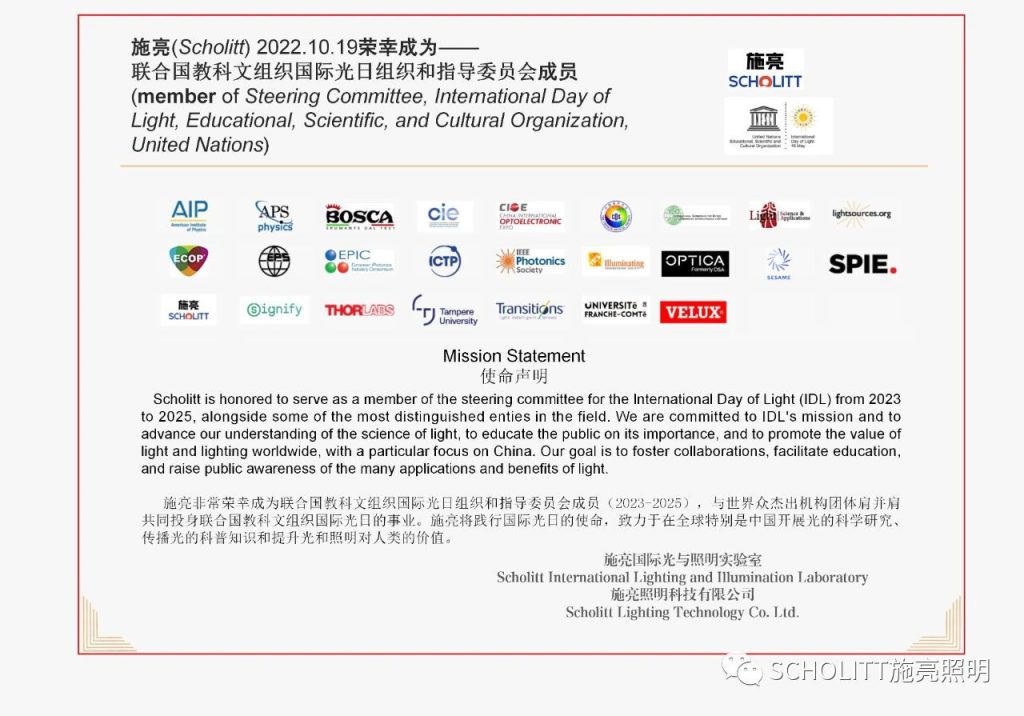
施亮Scholitt于2022/10/19正式成为
价值创造是施亮一切行为的导向。施亮以定义和解决关系人类健康和福祉的照明问题和挑战为己任,探索自然可见光及其形成的光照环境与人和其他生物体的在生理、心理情绪、认知行为上的关联和相关效应,并探索人类在室内通过照明方式实现这些关联和效应的必要性和方法。
施亮以基于优势智力资源聚集、激发、运用的科技、市场、行业创新寻求各种问题的最优解。
施亮将践行“国际光日”的使命,致力于在全球特别是中国开展光的科学研究、传播光的科普知识和提升光和照明对人类的价值。
The value creation is Scholitt’s guiding principle. We take it as our mission to define and solve lighting problems and challenges that relate to human health and well-being, explore the relationship and effects of natural visible light and the lighting environment on the physiology, psychology, emotions, cognition, and behavior of humans and other living organisms. We also investigate the necessity of and methods for achieving these associations and effects indoors through lighting.
Scholitt seeks the optimal solution to various problems through technological, market, and industry innovation based on pooled, stimulated and applied intellectual resources.Scholitt is committed to the mission of “International Day of Light” to promote scientific research on light, popularize knowledge of light around the world especially in China, and enhance the value of light and lighting for human beings.
Scholitt is committed to the mission of “International Day of Light” to promote scientific research on light, popularize knowledge of light around the world especially in China, and enhance the value of light and lighting for human beings.
5月16日“国际光日”由联合国教科文组织倡议设立,旨为促进人们理解光在科学、文化、艺术、教育和可持续发展等领域中扮演的重要角色,探索光在医药、通信、能源等领域的应用,创造世界更美好的未来。
The International Day of Light on May 16th is initiated by UNESCO to promote people’s understanding of the important role light plays in science, culture, art, education, and sustainable development. It explores the application of light in fields such as medicine, communication, and energy, and creates a better future for the world.
光与知识并行不悖,是我们借以观察和理解世界的透镜。观察和理解,这是一种超越所有差异和边界的深层次人类需求。“国际光日”礼赞光在物理、社会和艺术中的应用,并力图增进人们对光的了解。首要目标便是提高公众对光和基于光的技术如何影响每个人的日常生活以及对全球社会未来发展至关重要的认识,强调光基础科学基础研究的重要性、投资于光基技术以开发新应用的必要性,以及促进这些领域的科学和工程事业的全球必要性。
Light goes hand in hand with knowledge; it is a lens through which to see and understand the world. The need to observe and to understand is a profoundly human need that transcends all differences and borders. The International Day of Light celebrates the physical, social and artistic uses of light, and aims to promote a better understanding of it. The primary goal is to improve the public understanding of how light and light-based technologies touch the daily lives of everybody, and are central to the future development of the global society, and emphasise the importance of basic research in the fundamental science of light, the need for investment in light-based technology to develop new applications, and the global necessity to promote careers in science and engineering in these fields.
光也一直是对人类无法逾越的终极疆域即空间和时间的一种形而上的体验。在这方面,如同充满活力的这一科学领域一样,对我们智人而言,光不仅是一种通往知识的门户和知识的源泉,它还直抵人类体验的核心所在,即我们的情感、感受和某种诗意。光也正处于教科文组织各项任务的交汇点。所以“国际光日”同时也从可持续发展目标的角度出发,强调照明技术的重要性以及获得照明和能源基础设施对可持续发展和提高发展中国家生活质量的必要性;突出并阐释光与艺术文化的紧密联系,增强光学技术在保护文化遗产中的作用;解决性别平衡问题,并特别关注发展中国家和新兴经济体,建立全球教育能力。
Light has also been a metaphysical experience of space and time – the final and ultimate frontier of humankind. In this respect, and as dynamic as this field of science is, for Homo sapiens, light is not only a gateway to and a source of knowledge. It also represents the very heart of the human experience – our emotions, our feelings, and a certain sense of poetry. Light is also at the very crossroads of all the components of UNESCO’s mandate. Therefore, International Day of Light also emphasizes, from the perspective of sustainable development goals, the importance of lighting technology and the necessity of obtaining lighting and energy infrastructure for sustainable development and improving the quality of life in developing countries. It highlights and explains the close connection between light and art and culture, and enhances the role of optical technology in protecting cultural heritage, and addresses gender balance issues, and particularly focuses on developing countries and emerging economies to establish global education capacity.
无论是旨在促进更开放的科学和助力研究人员特别是女性研究人员职业发展的所有行动,还是我们对教育、文化多样性和遗产多样性以及信息的自由传播所作承诺,“国际光日”的工作始终聚焦同一个目标:照亮未来。
From making science more open and promoting careers in research, especially for women, to making commitments to education, to cultural diversity and diversity of heritage, and to the free distribution of information, our organization’s efforts all share a single vision – a brighter future.
一百万年前,原始人类学会用火,火光为太阳消失在地平线后的漆黑提供一点光亮;一万多年前,人类使用脂油灯、蜡烛,将以往只能在白天的活动延伸至夜晚;19世纪至20世纪的近两百年时间,电光源的发展使人类突破昼夜限制;21世纪,LED划过时代的星空,点亮世界,革命性的光源,如何为人类带来新的价值是施亮一直思考的问题。
Humanity learned to use fire one million years ago, providing light in the darkness after the sun disappeared on the horizon. Over ten thousand years ago, humans began using oil lamps and candles, extending activities beyond daylight hours. Over the next two hundred years, the development of electric light sources allowed humanity to break through the limits of day and night. In the 21st century, LED technology lit up the world, and Scholitt has been considering how to bring new value to humanity.
电光源在过去的200多年为自然光线不足时提供视觉支撑,拓展了人类活动的时间与空间。当今社会,人类90%的时间在室内度过,高度依赖人工照明。然而室内人工照明与自然光相去甚远,这种差异带来的问题也日益突显,如户外高光照度、活动时长与近视的发生发展密切相关;白天照度不足,褪黑色素分泌延迟导致昼夜节律失调,造成情绪障碍,影响青少年发育等。
Over the past two hundred years, electric light sources have provided visual support when natural light is insufficient, extending human activity time and space. In today’s society, humans spend 90% of their time indoors and rely heavily on artificial lighting. However, indoor artificial lighting is far from natural light, and the problems caused by this difference are becoming increasingly prominent. For example, outdoor high illuminance and activity duration have a significant correlation with the incidence and development of myopia; insufficient daytime illumination delays the secretion of melatonin, leading to circadian rhythm disorders, emotional disorders, and affecting adolescent development.
施亮明明地看到了人类从广厦千万的围合墙壁的窗口透出对户外自然的热切目光,明明地听到了人类渴望从精神价值被漠视的物理性照明中回归的呐喊。
Scholitt clearly sees the enthusiastic gaze of humanity through the windows of the tens of millions of enclosed walls, yearning for nature outdoors, and can also hear the cry of humanity longing to return from materialistic lighting that neglects spiritual values.
施亮希望从人的角度审视照明在替代自然光照这一过程的历史轨迹及其原因,通过以物理、化学、材料等学科主导,结合生物学、临床医学、心理学与认知神经科学等学科的方式寻求对当前室内人工照明理念、方法和可能存在的缺失的充分把握,并构建消除这些缺失的较为可靠的逻辑和科学方法。
Scholitt hopes to examine the historical trajectory and reasons for lighting replacing natural light from a human perspective. We seek to use disciplines such as physics, chemistry, and materials science, combined with biology, clinical medicine, psychology, and cognitive neuroscience, to fully understand the current concept, methods, and potential shortcomings of indoor artificial lighting. Scholitt aims to construct a logical and scientific approach to eliminate these shortcomings reliably.
施亮作为联合国教科文国际光日组织和指导委员会的一员(2023-2025),与世界众杰出机构团体肩并肩共同投身联合国教科文组织国际光日的事业。施亮站在人类健康和福祉的高度,在急需破局的人因照明全域,以给予生命体复杂性充分理解和预留充足空间的态度,以解决复杂性科学问题的思维,打破思维桎梏,勇于在“无人区”推进了理论探索创新与成果应用落地。
Scholitt is a member of the UNESCO International Day of Light and Steering Committee for 2023-2025, working together with outstanding organizations and groups around the world to promote the mission of UNESCO International Day of Light. Scholitt stands at a high level of human health and well-being, breaking through the thinking shackles with a mindset of solving complex scientific problems, and boldly exploring and innovating in theoretical exploration and application landing in the “no man’s land.” With an attitude of giving life’s complexity full understanding and sufficient space to solve the issue of universal lighting for humans, Scholitt has made significant contributions.